I landed in Arusha assuming I had a rough idea of what Tanzania would be like, mostly built from documentaries and a handful of photos friends had shown me over the years.
I pictured wide open plains, maybe a few elephants in the distance, the kind of scenery you scroll past on a screen without really absorbing.
Within the first three days, that idea had completely fallen apart. Tanzania doesn’t just show you wildlife from a comfortable distance.
It puts you on foot in the same grass as elephants, inside a boma learning a dance you’re bad at, or airborne at sunrise watching a migration stretch to the horizon.

It reshapes how you think about travel, not through anything staged, but through moments that simply happen while you’re paying attention.
This list covers the eleven experiences that stuck with me most from that trip, along with a few that came so strongly recommended by guides and fellow travelers along the way that leaving them out felt wrong.
If you’re already building out a bigger travel wish list, our dream vacations bucket list and most incredible hiking trips guide are worth a look once you’re done here, especially if Kilimanjaro’s lower trails end up sparking a taste for more.
What Makes a Tanzania Experience Actually Epic

Looking back across all eleven of these, the moments that stuck with us weren’t the ones we planned most carefully. They were the ones where something unscripted happened.
A lion in a tree nobody expected, a pod of dolphins that showed up uninvited, a village dance we had no choice but to join badly. Tanzania rewards travelers who leave a little room for that.
A few things tie every entry on this list together
- Distance and effort are part of the reward. The remoteness of Mahale or the early wake up for a balloon launch is not a downside to work around. It is part of why the experience lands the way it does.
- Guides make or break it. Whether it is a ranger on a walking safari, a tracker in the forest, or a Maasai host explaining the boma, the person leading you shapes the experience as much as the place itself.
- Wildlife does not perform on schedule. Balloon rides get cancelled for wind, chimps move deeper into the forest, lions are not always in the trees. Flexibility matters more here than almost anywhere else.
- Combining experiences beats chasing one. Pairing a walking safari with a balloon ride, or a village visit with time in Manyara, gives a fuller picture than any single stop on its own.
Planning tip
Build in at least one unplanned day somewhere in the itinerary. Across every experience on this list, the details that made a place memorable were rarely the ones on the schedule.
Safety tip
Book through reputable operators for anything involving wildlife, remote travel, or community visits.
Tanzania rewards a bit of spontaneity, but the safest version of that spontaneity still runs through experienced guides who know the terrain and the animals.
1. Witnessing the Great Migration in the Serengeti

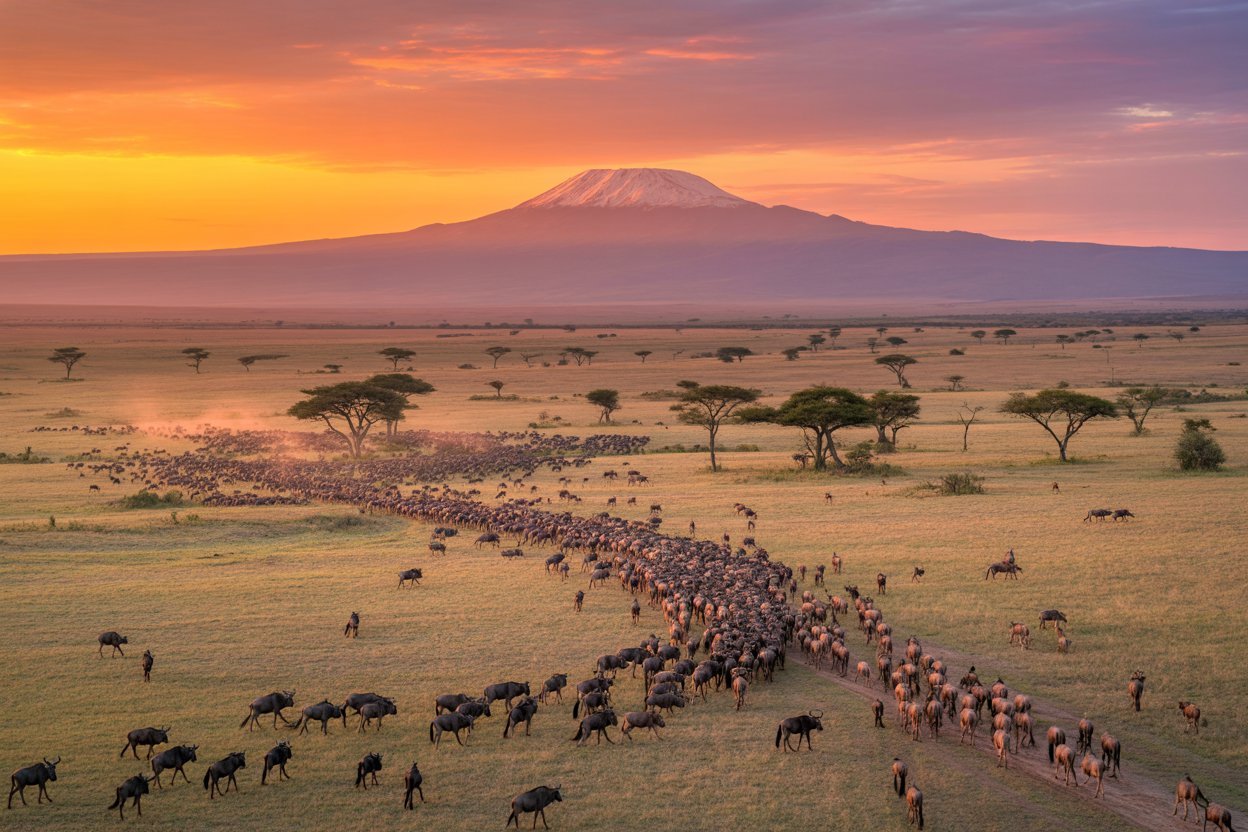
Nothing quite prepares you for the scale of the Great Migration, even after watching every nature documentary that covers it.
Standing at a quieter viewpoint away from the main crossing points, watching the herds stretch to the horizon in every direction, gave me a completely different sense of scale than the dramatic river crossing footage everyone’s seen a hundred times.
How to get there Kilimanjaro International Airport (JRO) is the main gateway, with a connecting domestic flight or road transfer to Arusha, the typical starting point for Serengeti safaris.
From Arusha, small chartered flights into the park itself are common, since the drive can take six hours or more.
Where to stay
- Budget: Public campsites or lodges just outside the park offer a more affordable safari experience with fewer amenities.
- Mid-range: A tented camp near the park balances comfort and cost, typically including guided game drives as part of the package.
- Luxury: A high-end permanent tented camp positioned along seasonal migration routes, several with private plunge pools, is the standout splurge here.
Where to eat Nearly all dining happens through your camp or lodge, since the Serengeti has no towns or independent restaurants within the park.
Better properties genuinely put effort into fresh, locally sourced meals despite the remote setting, built around the day’s game drive schedule.
How to navigate No rental car for a Serengeti safari, guided game drives in a proper safari vehicle, arranged through your camp or a licensed tour operator, are how you experience the park. Book through a reputable operator well ahead of peak migration season.
Things to do
- Take multiple game drives at different times of day for different wildlife activity
- Watch a river crossing if your visit aligns with the migration’s seasonal position
- Take a sunrise hot air balloon ride over the plains
- Visit a nearby Maasai village with a respectful, guided tour
Best time to visit: June to October for reliable dry season conditions and strong migration viewing, though exact timing shifts year to year based on rainfall.
Personal tip: Ask your guide about quieter viewpoints away from the main crossing points. The scale of the herds spread across open plains can be just as striking as a single dramatic crossing, with far fewer other vehicles around.
Safety tip Always stay inside the vehicle during game drives, since wildlife here is genuinely unpredictable despite how calm it may appear.
Malaria risk exists in this region, so speak with a travel doctor about preventive medication well before your trip. Our 11 most beautiful places to visit on earth covers a few similarly dramatic natural landscapes worth comparing.
2. Descending Into Ngorongoro Crater

Ngorongoro Crater is often called Africa’s Eden, and after spending a full day inside it, I understood why.
Watching mist slowly clear off the crater floor at sunrise, with lions moving through the grass below before the day’s heat set in, remains one of the most striking wildlife moments I’ve witnessed anywhere.
How to get there Kilimanjaro International Airport (JRO) is the main gateway, with a road transfer of roughly four to five hours to the crater rim, often combined with a stop in Arusha along the way.
Small chartered flights to a nearby airstrip are also an option if you’re combining this with other parks.
Where to stay
- Budget: Campsites on the crater rim offer a genuinely more affordable way to experience Ngorongoro, though with fewer amenities than the lodges.
- Mid-range: A mid-tier lodge on the crater rim balances comfort and cost, typically including guided crater descents as part of the package.
- Luxury: A high-end lodge with private crater-facing rooms and dedicated guides is the standout Ngorongoro splurge, worth it for the views alone.
Where to eat Dining happens almost entirely through your lodge here, since there’s no independent restaurant scene this close to the crater.
Better properties serve genuinely good food despite the remote location, often featuring fresh produce brought in from nearby farming communities.
How to navigate Descending into the crater requires a permit and a guided vehicle, arranged through your lodge or a licensed operator, since independent access isn’t permitted.
Book your descent the night before if possible, since early entry gives the best wildlife viewing before other vehicles arrive.
Things to do
- Take a full-day guided descent into the crater floor
- Look for the “big five” in unusually high density given the crater’s contained ecosystem
- Visit a nearby Maasai village for a guided cultural visit
- Walk part of the crater rim trail for panoramic views without a vehicle
Best time to visit: June to October for reliable dry conditions, though the crater’s high density of wildlife makes it rewarding nearly year-round.
Personal tip: Go early. Getting to the crater rim before sunrise and starting your descent as the mist clears gave me significantly better wildlife sightings than a later, more crowded start.
Safety tip: Stay inside the vehicle at all times during the descent, since the crater’s contained wildlife density means encounters happen at closer range than in the open Serengeti.
Altitude at the crater rim can affect some visitors, so take it slow if you’re prone to altitude sensitivity. Our dream vacations bucket list covers more wildlife-focused destinations worth comparing.
3. Climbing Part of Mount Kilimanjaro

You don’t need to summit Kilimanjaro to have a meaningful experience on its slopes.
Even a day hike into the lower forest zones gives you a completely different perspective on Africa’s highest peak, and standing among genuine rainforest at the base, with the mountain still hidden in cloud above, was enough to make me understand the pull of a full summit attempt without needing to commit to one myself.
How to get there Kilimanjaro International Airport (JRO) sits close to the mountain itself, with a short transfer of about an hour to Moshi, the main town used as a base for climbs and day hikes.
Where to stay
- Budget: Guesthouses in Moshi offer solid value while putting you close to trailheads and tour operators.
- Mid-range: A standard hotel in Moshi or nearby Marangu balances comfort and cost, both common bases for organizing a climb or day hike.
- Luxury: A high-end lodge with mountain views near Marangu, several offering private guided treks, is the standout splurge for this experience.
Where to eat Moshi has a genuinely solid range of restaurants for a town its size, built around the steady flow of climbers and trekkers passing through.
Local Tanzanian dishes, ugali, nyama choma, fresh tilapia from nearby Lake Chala, are worth seeking out over the more generic tourist-menu spots near the main tour operator offices.
How to navigate You won’t need a rental car for this, since access to the mountain’s gates is arranged through your tour operator or lodge, typically including transport.
Book a day hike or multi-day trek through a licensed, reputable operator, since park access requires permits arranged in advance.
Things to do
- Take a day hike through the Marangu or Machame gate forest sections
- Visit a local coffee farm near Moshi as a lower-effort alternative day trip
- Consider a multi-day summit attempt if your schedule and fitness allow it
- Visit the Chagga cultural sites near the mountain’s base for local history
Best time to visit: January to March or June to October, the driest windows for both day hikes and full summit attempts.
Personal tip: If a full summit attempt isn’t in your plans, ask a local operator about a day hike through the Marangu or Machame gate forest sections.
It’s a manageable way to experience part of the mountain without committing to a multi-day trek.
Safety tip Even short hikes here benefit from proper footwear and rain protection, since the forest zone gets genuinely wet regardless of season.
If attempting a full summit, altitude sickness is a real risk, so choose a route and operator with a gradual acclimatization schedule rather than the fastest, cheapest option.
Our 11 most beautiful places to visit on earth covers a few similarly iconic natural landmarks worth comparing.
4. Relaxing on the Beaches of Zanzibar

After days of early wake-up calls on safari, Zanzibar felt like an entirely different trip.
Watching the tide pull back dramatically in the late afternoon, revealing sandbars that stretched out toward the horizon, gave me the kind of slow, unstructured beach time I hadn’t realized how badly I needed after a week of dawn game drives.
How to get there Abeid Amani Karume International Airport (ZNZ) in Zanzibar Town has direct flights from several African and European hubs, along with a short domestic connection from Dar es Salaam or Kilimanjaro if you’re combining this with mainland Tanzania.
Where to stay
- Budget: Guesthouses in Paje or Jambiani offer solid value while still putting you steps from the beach.
- Mid-range: A standard beachfront hotel along the east coast balances comfort and cost, with easy access to water sports and restaurants.
- Luxury: A private beachfront villa or high-end resort near Nungwi, several offering couples-specific packages, is the standout Zanzibar splurge.
Where to eat Beachfront restaurants along the main tourist strips charge more for the location and view.
For better value, head a street or two back, where local Swahili and seafood dishes, octopus curry, spiced fish, fresh coconut rice, are served at noticeably lower prices with genuinely excellent flavor.
How to navigate Renting a scooter or arranging a local driver is the easiest way to explore the island’s different beach towns, since public transport is limited and taxis can be pricier than expected for longer distances.
Stone Town itself is walkable, with a car or driver useful for reaching the coast.
Things to do
- Relax on the beach in Paje or Jambiani, both known for kitesurfing conditions
- Explore Stone Town’s winding streets and spice markets
- Take a sunset dhow cruise along the coast
- Visit a spice farm for a guided tour of the island’s agricultural history
Best time to visit: June to October or December to February, avoiding the long rains in April and May.
Personal tip: Check tide charts before planning a beach day, since Zanzibar’s east coast has dramatic tidal swings that significantly change swimming conditions throughout the day.
Safety tip Strong currents can develop at certain tide points, so ask locally about safe swimming windows rather than assuming any time of day is fine.
Sun protection matters more here than people expect, given how close the island sits to the equator.
Our 12 cheapest islands to visit in 2026 covers more affordable beach destinations worth comparing if Zanzibar’s resort pricing surprises you.
5. Exploring Stone Town, Zanzibar

Stone Town is a maze of narrow alleys, carved wooden doors, and centuries of layered history from Arab, Persian, Indian, and European influence.
Getting genuinely lost here on purpose, following whatever smell of spices or sound of a call to prayer pulled me down the next alley, turned into one of my favorite unplanned afternoons of the entire Tanzania trip.
How to get there Abeid Amani Karume International Airport (ZNZ) sits about a 15-minute drive from Stone Town itself, making this one of the more convenient stops on this list to reach directly.
Where to stay
- Budget: Guesthouses within Stone Town’s old buildings offer genuine character at a lower price than the beach resorts, with easy walking access to everything.
- Mid-range: A converted heritage building turned boutique hotel balances atmosphere and cost well, common throughout the historic center.
- Luxury: A high-end heritage hotel with a rooftop terrace overlooking the harbor, several occupying genuinely historic buildings, is the standout Stone Town splurge.
Where to eat The Forodhani Gardens night market, set up along the waterfront each evening, is worth experiencing at least once for grilled seafood skewers and Zanzibar pizza, though quality varies by stall, so go where the crowds of locals gather.
For a calmer meal, smaller restaurants tucked into Stone Town’s side streets consistently offer better value than the main tourist-facing spots.
How to navigate Stone Town is entirely walkable and genuinely best explored on foot, since the narrow alleys aren’t suited to cars at all.
A local guide for the first hour is worth it, since the maze-like layout means a lot gets missed wandering completely blind.
Things to do
- Wander the alleys and spice markets with no fixed destination
- Visit the House of Wonders and other historic buildings
- Eat at the Forodhani Gardens night market
- Take a guided walking tour focused on the town’s slave trade history
Best time to visit: June to October or December to February, avoiding the long rains.
Personal tip: Hire a local guide for just the first hour. Mine pointed out details in the carved doors and old buildings I would have completely walked past on my own, then let me wander freely for the rest of the afternoon with a much better sense of what I was looking at.
Safety tip The alleys can be genuinely disorienting, so keep your accommodation’s address and a phone with maps handy in case you need to reorient.
Dress modestly when visiting religious sites or walking through more traditional neighborhoods, out of cultural respect. Our 11 dreamy Irish village hotels covers a very different but similarly historic, walkable destination worth comparing.
6. Taking a Walking Safari in Tarangire National Park

We stepped out of the truck at sunrise with a guide and an armed ranger a few paces behind, nothing but our own footsteps in the dry grass.
A herd of elephants moved through the acacia trees maybe a hundred yards off, close enough that we both stopped breathing for a second. No engine, no windshield between us and them.
Why it is worth it
Tarangire is known for its elephant herds and ancient baobab trees, but most visitors only see it from a vehicle.
Walking through it puts you at ground level with the wildlife and the small details a truck window usually blurs past.
How to get there
Tarangire sits about two hours from Arusha by road, the usual starting point for most northern circuit safaris.
Kilimanjaro International Airport (JRO) is the main gateway, with a smaller strip near the park for those flying in directly with a safari operator.
Where to stay
- Budget: Campsites just outside the park gate keep costs down.
- Mid range: Lodges bordering the park offer comfortable rooms without the flagship price tag.
- Luxury: Tented camps inside or overlooking the park, some with views over the riverbed where elephants gather.
How to eat around there
Meals are almost always included through your lodge or camp, since there is little outside the park itself. Some walking safaris include a bush breakfast partway through.
Getting around
A 4×4 safari vehicle with your operator handles all transport between camp and the walk’s starting point. Walking is confined to the guided route itself, always with your guide and ranger.
What to expect
- A licensed guide alongside an armed ranger
- Small groups, often six people or fewer
- A focus on tracking, plants, and insects alongside big game
- Walks of one to three hours, usually at sunrise
Best time to go: June to October, dry season, for predictable wildlife and shorter grass.
Personal tip: Ask your guide questions constantly. Ours pointed out lion tracks we’d have missed entirely.
Safety tip: Follow your guide’s instructions on pace and noise immediately, not after a photo.
7. Visiting a Maasai Village

We were pulled into a circle of jumping and singing within minutes of arriving, no real choice in the matter, and spent the next hour badly attempting the adumu jump while Maasai women laughed and corrected our form.
It’s less a performance and more an invitation to be genuinely bad at something together.
Why it is worth it
The Maasai have lived across northern Tanzania for centuries, and a village visit offers a direct look at a culture that has kept its traditions while adapting to modern life.
How to get there
Most villages open to visitors sit near the main safari circuits, close to Ngorongoro, Tarangire, or Lake Manyara.
Visits are almost always booked through a safari operator or lodge, who arranges transport as part of the day’s itinerary.
Where to stay
- Budget: Basic guesthouses in nearby towns like Mto wa Mbu.
- Mid range: Tented camps near Lake Manyara or Ngorongoro.
- Luxury: Lodges bordering the conservation areas, often with visits built into the guest experience.
How to eat around there
There are no restaurants inside the villages, so meals run through your lodge or camp. Some villages offer a taste of ugali or chai as part of the visit, usually included in the arranged fee.
Getting around
Travel is almost always by safari vehicle arranged through your guide or lodge, since roads to villages can be unpaved. Walking within the village is normal once you arrive.
What to expect
- Traditional singing and the adumu jumping dance
- A walk through the boma, or homestead
- Beadwork and jewelry for sale, made by the women themselves
- A small entrance fee that supports the community
Best time to go: Year round, so timing depends more on your safari itinerary than weather.
Personal tip: Bring small bills, and ask before photographing individuals.
Safety tip: Stick to arranged, reputable visits, follow your guide’s lead on where to go, and keep valuables minimal.
8. Chimpanzee Trekking in Mahale Mountains

We climbed through thick forest for almost two hours, soaked in sweat and half convinced we’d taken a wrong turn, when our guide suddenly went still and pointed up.
A chimpanzee sat directly above us, completely unbothered, peeling a piece of fruit. Every ache from the climb stopped mattering.
Why it is worth it
Mahale is one of the last places on earth to see wild chimpanzees in an untouched forest setting, without crowds or roads nearby. It takes real effort to get here, which is exactly why it still feels wild.
How to get there
Mahale is remote, reachable mainly by small chartered flight from Arusha or Dar es Salaam to an airstrip near the park, followed by a boat ride along Lake Tanganyika to reach camp. There are no roads connecting Mahale to the rest of the country.
Where to stay
- Budget: A public campsite near the park offers the only low cost option.
- Mid range: A handful of simple tented camps along the lakeshore.
- Luxury: Remote lakeside camps with private bandas, most including all meals and trekking permits.
How to eat around there
Nearly all meals happen through your camp, since there is no town or restaurant scene nearby. Most packages include full board given the remoteness.
Getting around
Boats along Lake Tanganyika connect camps to the park entrance, and trekking on foot is the only way to reach the chimpanzees once inside the forest.
What to expect
- Treks ranging from one to six hours depending on where the chimps are that day
- Small groups led by an experienced guide and tracker
- Steep, sometimes slippery forest terrain
- A strict one hour limit once you reach the chimpanzees
Best time to go: May to October, dry season, for easier trekking conditions.
Personal tip: Wear real hiking boots. This is not a casual walk, and the terrain punishes flip flops and sneakers alike.
Safety tip: Keep a respectful distance from the chimpanzees and follow your guide’s lead, since they can carry diseases transmissible to humans and vice versa.
9. Taking a Hot Air Balloon Ride Over the Serengeti

We lifted off in near total silence except for the occasional burst of the burner, watching the Serengeti turn gold beneath us as the sun came up.
A line of wildebeest stretched to the horizon like a shadow across the grass. Neither of us said much. There wasn’t really anything to add.
Why it is worth it
A balloon ride gives you a view of the Serengeti that no vehicle ever could, drifting silently over herds and rivers at sunrise. It is one of the few ways to see the scale of the migration all at once.
How to get there
Balloon launches take place from camps within the Serengeti itself, so you need to already be staying inside or near the park. Most people fly into Seronera or another Serengeti airstrip from Arusha, then transfer to camp by vehicle.
Where to stay
- Budget: Public campsites within the Serengeti keep costs down, though balloon rides still carry a fixed premium price.
- Mid range: Lodges near the central Seronera area put you close to launch sites.
- Luxury: Tented camps that arrange balloon pickup directly from camp before sunrise.
How to eat around there
Balloon rides traditionally end with a champagne breakfast set up in the bush, included in the price. Otherwise, meals run through your lodge or camp as usual.
Getting around
A vehicle collects you from camp in the dark for the launch site, and the same vehicle meets the balloon after landing to bring you to breakfast. No independent transport is needed.
What to expect
- An early wake up, often around 5am, for a sunrise launch
- Roughly an hour in the air, drifting at varying heights over the plains
- A landing followed by a champagne bush breakfast
- A fixed, somewhat high price point compared to other activities on this list
Best time to go: June to October for the dry season, or during the wildebeest migration months for the best chance of seeing herds from above.
Personal tip: Book the earliest possible slot. Being airborne right as the sun comes up over the plains is worth losing the sleep.
Safety tip: Balloon safaris are weather dependent and can be cancelled last minute for wind, so avoid scheduling one on your final morning in case it needs to be rescheduled.
10. Snorkeling or Diving Around Mnemba Atoll

We slipped into the water expecting the usual scattered reef fish and instead swam straight into a pod of dolphins circling the boat, close enough to hear them clicking underwater.
Our guide just laughed and said some days are like that around here. We stayed in far longer than planned.
Why it is worth it
Mnemba Atoll off Zanzibar’s coast is known for clear water, healthy coral, and consistent marine life, from reef fish to the occasional dolphin pod.
It is one of the easiest ways to add something completely different to a Tanzania itinerary built mostly around safari.
How to get there
Most trips depart by boat from the northeast coast of Zanzibar, typically from Matemwe or Nungwi. Zanzibar is reached by short flight from Dar es Salaam or Arusha, or by ferry from Dar es Salaam.
Where to stay
- Budget: Guesthouses in Nungwi offer easy access to boat departures at low cost.
- Mid range: Beachfront hotels in Matemwe put you closest to the atoll itself.
- Luxury: Boutique resorts along the northeast coast, several offering private boat transfers to the reef.
How to eat around there
Matemwe and Nungwi both have a real restaurant scene, unlike most safari stops on this list, ranging from casual beach grills to upscale seafood. Many trips also include a light lunch or snacks on the boat.
Getting around
Boats handle the trip out to the atoll itself, usually arranged through your hotel or a local dive operator. On land, taxis or hotel transfers cover short distances along the coast.
What to expect
- Calm, clear water well suited to both snorkeling and diving
- Healthy coral and a wide range of reef fish
- Occasional sightings of dolphins or turtles
- Half day trips are most common, usually including two snorkel or dive stops
Best time to go: June to October or December to February, avoiding the rainy seasons for the clearest water.
Personal tip: Bring reef safe sunscreen. The coral here is genuinely healthy, and it is worth keeping it that way.
Safety tip: Check conditions with your operator before booking, since currents around the atoll can be stronger than they look from the surface.
11. Exploring Lake Manyara National Park

We rounded a bend in the road and stopped the vehicle dead in the middle of the track, staring up into a tree at a lion draped across a low branch, completely unbothered by us.
Our guide said it still surprises him every time. Lake Manyara has a way of turning a quiet afternoon into a story you tell for years.
Why it is worth it
Lake Manyara is smaller and often overlooked next to the Serengeti and Ngorongoro, but it packs in dense forest, open grassland, and a soda lake within a compact area.
It is best known for its tree climbing lions and large flocks of flamingos along the shoreline.
How to get there
The park sits about two hours from Arusha by road, making it an easy stop on the way to or from the Serengeti and Ngorongoro. Kilimanjaro International Airport is the usual entry point for most travelers.
Where to stay
- Budget: Campsites near the park gate keep things simple and affordable.
- Mid range: Lodges in nearby Mto wa Mbu offer comfortable rooms close to the entrance.
- Luxury: Lodges perched on the escarpment above the park, with sweeping views over the lake and rift valley.
How to eat around there
Mto wa Mbu has a modest but real selection of local restaurants alongside the usual lodge dining. Most safari days still run on packed lunches or meals included through your camp.
Getting around
A 4×4 safari vehicle is standard for exploring the park, with your guide handling all driving between viewing spots along the lakeshore and forest tracks.
What to expect
- A chance at spotting tree climbing lions, a rare behavior mostly seen here
- Large flocks of flamingos along the lake, especially when water levels are right
- Dense groundwater forest near the entrance, unusual for a safari park
- A good half day or full day add on alongside a longer northern circuit itinerary
Best time to go: June to October for dry season game viewing, or the wet season for the best flamingo numbers.
Personal tip: Keep your eyes on the trees, not just the ground. The tree climbing lions are the whole reason people come here, and they blend in more than you’d expect.
Safety tip: Stay inside the vehicle at all times in areas with large predators, since the forest sections make animals harder to spot until you’re close.
More Tips for Planning a Tanzania Trip

A few things I wish I’d known before booking my own trip:
- Choose your season around your priorities. June through October is best for the migration and drier conditions, while November through May offers lower prices and lush green scenery, though with more rain.
- Budget for park fees separately from your safari cost. Tanzania’s national parks charge daily conservation fees that add up quickly, especially across a multi park itinerary.
- Pack neutral colored clothing. Bright colors and dark blues can attract tsetse flies in certain regions, and khaki or muted tones are far more practical for game drives.
- Build in buffer days for remote experiences. Chimp trekking and certain walking safaris aren’t guaranteed on the first try, and flexibility improves your odds significantly.
- Combine safari with beach time if your schedule allows. Pairing a few days in the Serengeti or Ngorongoro with time in Zanzibar gives the trip a completely different rhythm and lets you recover before flying home.
- Pack light but smart. A well organized bag makes a real difference on multi stop safaris with small aircraft transfers. Our backpacking essentials guide and travel checklist are both useful starting points before you pack.
FAQ
How many days do you need for a good Tanzania trip? I’d budget at least ten days if you want to combine safari with beach time in Zanzibar.
A shorter seven day trip works if you’re focused purely on the northern safari circuit, but I regretted rushing my own first visit and gave myself more time on a return trip.
Is Tanzania safe for travelers? I felt safe throughout my trip, especially on organized safaris and in well established tourist areas like Stone Town and the northern parks.
As with anywhere, I stayed alert in busier markets and always used a reputable local operator rather than booking last minute with unfamiliar guides.
Do I need a visa to visit Tanzania? Most visitors need a visa, and I found it easiest to apply online in advance rather than dealing with the arrival process at the airport.
Requirements vary by nationality, so I’d recommend checking your country’s specific rules before you book flights.
What’s the best time of year to visit for the migration? June through October gave me the most reliable dry season weather and strong migration viewing when I went, though the exact timing shifts slightly each year based on rainfall.
If seeing a river crossing specifically matters to you, ask your operator for the most current migration position before locking in dates.
Is Tanzania expensive to visit? Safaris themselves aren’t cheap, largely due to park fees and the cost of small aircraft transfers between regions, but I found ways to balance the budget by pairing a shorter safari with more affordable beach time in Zanzibar afterward.
Our guide to budget friendly places to travel has more general tips that applied well to how I planned this trip.
Can you do a Tanzania safari without a guide? I wouldn’t recommend it, and most parks actually require a licensed guide for game drives.
Beyond the legal requirement, my guides added context and spotted wildlife I would have completely missed on my own, which made a noticeable difference in how much I got out of each day.
Final Thoughts
Eleven experiences, and every one of them left me with a completely different feeling than the last, from the noise of a river crossing to the total silence of a hot air balloon drifting over the plains at sunrise.
Tanzania has a way of making even a well planned itinerary feel unpredictable in the best possible way.
If you’re still deciding where this trip fits into your bigger travel plans, our guides to budget friendly places to travel and the best places to travel this year are worth a look, and our dream vacations bucket list has more destinations that pair naturally with a trip like this one. Whichever of these eleven experiences pulls you in first, Tanzania has a strong track record of exceeding whatever expectations you show up with.